The Hidden Health & Environmental Cost of Plastic Coffee Pods

The Environmental and Health Impacts of Plastic Coffee Pods
You wake up, stumble to the kitchen, and pop a small plastic capsule into your machine—it’s a 30-second ritual that defines modern convenience, but have you ever stopped to wonder what that heat is actually doing to the plastic, and more importantly, to you? While we’ve been sold the dream of the perfect crema, the environmental and health impacts of plastic coffee pods have quietly escalated into a global crisis that goes far beyond just 'littering.'
In 2025, the data is undeniable: we are brewing a chemical soup. When we ask, 'What are the health risks of heating plastic coffee pods?' we aren't just talking about a bad aftertaste; we are talking about endocrine disruption and the ingestion of thousands of microparticles every single morning. This isn't just another 'eco-guilt' trip; it’s a deep dive into the sustainable brewing revolution and a guide to the best eco-friendly alternatives to plastic coffee pods 2025 so you can reclaim your health and your conscience.
If you've ever felt a nagging intuition that heating cheap plastic at high pressure might be a bad idea, you were right. Today, we’re pulling back the curtain on the coffee pods industry to reveal the science that big brands hope you’ll ignore. Let’s look at the lifecycle of a pod—from the extraction of petroleum to the microplastics currently circulating in your bloodstream.
The Truth About Plastic Coffee Pod Environmental Impacts
Imagine a line of discarded coffee pods that circles the Earth not once, not twice, but 12 times—that is the staggering reality of the waste we produce every single year. Most people believe that because their pods have a tiny recycling symbol, they are being 'green,' but the environmental and health impacts of plastic coffee pods are often masked by clever corporate greenwashing.
The truth is that the vast majority of plastic pods are non-recyclable in standard municipal systems. Because they are small, contaminated with organic coffee grounds, and often made of complex composite plastics (like #7 'Other'), they are rejected by sorting facilities and sent straight to landfills. Once there, they don't just sit; they begin a 500-year journey of slow degradation. What most people get wrong is thinking that 'biodegradable' means the pod disappears. In reality, without industrial composting, these pods simply fragment into smaller and smaller pieces, eventually entering our waterways.
"The coffee pod is the ultimate symbol of the 'throwaway culture'—a design that prioritizes 30 seconds of convenience over 500 years of planetary health." — Dr. Elena Rossi, Environmental Scientist.
We are currently facing a 'Pod-to-Landfill Ratio' that is unsustainable. For every 1 gram of coffee brewed, we produce roughly 3 grams of waste (including the pod, the lid, and the packaging). When you multiply this by the billions of people using coffee pods daily, the carbon footprint of the aluminum extraction, plastic polymerization, and global shipping creates an ecological debt that our children will be forced to pay.
Are Plastic Coffee Pods Safe? 3 Hidden Health Risks
Every time you press that 'brew' button, you are subjecting a thin layer of plastic to near-boiling water and high atmospheric pressure—a combination that is a recipe for chemical leaching. When we analyze what are the health risks of heating plastic coffee pods?, we have to look past the marketing and into the molecular biology of plastic migration.
- 1. Endocrine Disruption: Most plastic pods contain chemicals that mimic estrogen. When these chemicals leach into your hot coffee, they can interfere with your body’s hormonal signaling, potentially leading to metabolic issues and reproductive health concerns.
- 2. Phthalate Exposure: Even in pods labeled as safe, phthalates—used to make plastics flexible—can migrate into the liquid. These are known 'forever chemicals' that the body struggles to detoxify.
- 3. Thermal Degradation: Plastic isn't a static material; it is reactive. At 195°F (the standard brewing temperature), the structural integrity of the pod’s inner lining can begin to break down, releasing a cocktail of volatile organic compounds (VOCs) directly into your cup.
The environmental and health impacts of plastic coffee pods are inextricably linked. The same chemicals that poison the soil when a pod sits in a landfill are the ones that enter your body when the pod sits in your machine. We often focus on the caffeine kick, but we are ignoring the chemical 'hitchhikers' that come with it. Sustainable brewing isn't just about saving the trees; it’s about protecting your endocrine system from daily low-dose chemical exposure.
The Plastic Coffee Pod Health Impact: Microplastics Exposed
If you think you’re just drinking coffee, you might be surprised to learn that you are likely consuming a credit card's worth of plastic every single year—and your morning pod is a major contributor. Recent 2025 studies have utilized Raman spectroscopy to reveal that a single cup of coffee brewed in a plastic pod can contain upwards of 10,000 microplastic particles.
The microplastics found in coffee aren't just an abstract 'dirty' ingredient; they are small enough to cross the gut barrier and enter the bloodstream. Once in the blood, these particles can trigger inflammatory responses and oxidative stress. This is the 'Invisible Bio-Accumulation' framework: the more frequently you use high-heat plastic delivery systems, the higher your 'body burden' of synthetic polymers becomes.
Why this matters now: We are seeing a rise in 'unexplained' gut inflammation and autoimmune sensitivities. While coffee itself is a health food packed with antioxidants, the plastic delivery system acts as an anti-nutrient. By switching to sustainable brewing methods, you aren't just being an environmentalist—you are performing a vital act of preventative medicine for your cellular health.
Why BPA-Free Doesn’t Mean Chemical-Free
Don’t let the 'BPA-Free' sticker on your coffee pod box give you a false sense of security; it is one of the most successful marketing distractions in the history of the plastics industry. When manufacturers removed Bisphenol A (BPA) due to public outcry, they often replaced it with Bisphenol S (BPS) or Bisphenol F (BPF), which research suggests may be just as—if not more—hormonally active.
This is known in the scientific community as "Regrettable Substitution." You’ve traded one toxin for another that simply hasn't been regulated yet. In the context of the environmental and health impacts of plastic coffee pods, these BPA alternatives still exhibit 'Estrogenic Activity' (EA). When heated, these chemicals break free from the plastic matrix and bind to your hormone receptors, tricking your body into thinking it has more estrogen than it actually does.
The 2025 'Chemical Ghost' Reality
Even if a pod is technically 'food grade,' the combination of high heat, high pressure, and the natural acidity of coffee creates a perfect storm for chemical migration. Coffee is a natural solvent. When you force hot water through a plastic chamber, you aren't just extracting coffee oils; you are extracting the 'ghosts' of the manufacturing process—catalysts, UV stabilizers, and slip agents that were never meant to be ingested.
5 Shocking Facts: Plastic Coffee Pod Environmental Waste
To truly grasp the magnitude of this issue, we need to look at the raw, unfiltered data that rarely makes it into the glossy advertisements of major coffee brands. Here are five facts about the environmental and health impacts of plastic coffee pods that will change the way you look at your morning brew forever:
- Fact 1: The 19 Billion Problem. Over 19 billion plastic coffee pods are produced globally every year, and less than 5% of them are ever successfully recycled into new products.
- Fact 2: The Energy Debt. It takes approximately 4 times more energy to produce a plastic coffee pod than it does to produce the equivalent amount of loose-leaf coffee or ground beans.
- Fact 3: The Methane Menace. When coffee grounds are trapped inside a plastic pod in a landfill, they decompose anaerobically (without oxygen), producing methane—a greenhouse gas 25 times more potent than CO2.
- Fact 4: The 500-Year Ghost. A plastic pod used for 30 seconds today will still be present in some form in the year 2525. Your great-great-great-grandchildren will live on a planet still processing your 2025 espresso.
- Fact 5: The Microplastic Rain. As these pods break down in the environment, they contribute to the 'atmospheric microplastic cycle,' where plastic particles are picked up by the wind and fall back down as rain in even the most remote parts of the world.
These facts highlight why finding the best eco-friendly alternatives to plastic coffee pods 2025 is no longer an optional lifestyle choice—it is a planetary necessity. We are currently operating on an 'Ecological Credit Card' that has reached its limit.
How to Reduce Your Plastic Coffee Pod Environmental Impact
If you aren't ready to give up your machine just yet, don't panic—there is a middle ground that allows you to enjoy convenience without the heavy toxic load. Reducing your environmental and health impacts of plastic coffee pods starts with a 'triage' approach: eliminate the worst offenders first, then optimize your system.
The first and most effective step is switching to stainless steel reusable pods. These allow you to use your own high-quality, organic coffee grounds while completely bypassing the plastic heating process. Not only does this stop the flow of microplastics into your cup, but it also saves the average consumer over $400 a year. What most people get wrong is thinking reusable pods are 'messy.' Modern designs feature click-on lids and precision filters that make the process almost as fast as a disposable pod.
The 3-Step Impact Reduction Framework
- Audit Your Pods: Check the resin identification code. If it’s a #7, stop using it immediately. If it's a #5 (polypropylene), it's slightly more stable but still leaches chemicals when heated.
- The 'Grounds-Out' Rule: If you must use disposable pods, choose brands that are certified 'Home Compostable.' These are made from plant fibers and can be thrown in your garden, where they break down in weeks, not centuries.
- Scale Your Brewing: For your first cup, use a pod. For your second and third, switch to a French Press or Pour-over. Reducing your 'pod frequency' by 50% has a massive cumulative effect on your personal microplastics exposure.
Why Plastic-Free Pods Are the Ultimate Sustainable Choice
The future of the coffee industry isn't plastic; it’s plant-based and infinitely recyclable. In 2025, we have seen a massive surge in sustainable brewing technology that renders the traditional plastic pod obsolete. Plastic-free pods—made from materials like pressed paper, wood pulp, or medical-grade aluminum—are the gold standard for both the planet and your health.
Why is this the 'ultimate' choice? Because it solves the environmental and health impacts of plastic coffee pods at the source. When you remove the plastic, you remove the leaching. When you remove the plastic, you remove the landfill problem. Best eco-friendly alternatives to plastic coffee pods 2025 now include 'Naked Pods' (compressed coffee balls with a seaweed coating) and compostable paper pods that offer the same pressure-brewed taste without the chemical baggage.
Choosing plastic-free is a 'rebellious' act against a manufacturing system that values profit margins over human biology. It’s a statement that you refuse to be a part of the microplastics statistics. Furthermore, these alternatives often preserve the flavor profile of the coffee better, as plastic can impart a subtle 'synthetic' note to high-altitude beans. It’s a win-win: better taste, better health, better planet.
Plastic vs Aluminum Pods: Which Is Better for Your Health?
This is the debate that dominates the 2025 coffee forums: if I have to choose between plastic and aluminum, which one wins? When evaluating the environmental and health impacts of plastic coffee pods, aluminum is the clear winner, but with one important caveat. Aluminum is infinitely recyclable—meaning a pod you use today can be back on the shelf as a new product in 60 days. This creates a circular economy that plastic simply cannot match.
From a health perspective, aluminum pods are generally lined with a food-grade lacquer to prevent the metal from leaching into the coffee. While this lining is still a 'barrier,' it is significantly more stable under high heat than a pure plastic pod. What most people get wrong is the fear of aluminum toxicity; the amount of aluminum that could potentially leach from a lined pod is negligible compared to the massive amounts of microplastics and endocrine disruptors found in plastic pods.
The Health Verdict: If you cannot use a reusable stainless steel pod, aluminum is the superior choice. It offers a higher 'Thermal Stability Index' and doesn't contribute to the global microplastic crisis. However, always ensure the brand has a dedicated recycling take-back program to ensure that aluminum actually gets reused.
3 Secrets to a Healthier, Plastic-Free Coffee Ritual
You’ve made it this far, which means you’re ready to upgrade your morning routine from a toxic habit to a wellness ritual. Transitioning away from the environmental and health impacts of plastic coffee pods doesn't have to be a chore. Here are three 'insider secrets' to making your coffee ritual healthier and more sustainable in 2025:
- Secret 1: The 'Glass & Steel' Rule. Whenever possible, ensure that the only materials touching your hot coffee are glass, ceramic, or stainless steel. This is the only way to 100% guarantee a zero-plastic brew.
- Secret 2: Prioritize 'Water-Washed' Decaf. If you drink decaf pods, ensure they use the Swiss Water Process. Many plastic pods use chemical solvents for decaffeination which, when combined with the plastic pod itself, creates a double-dose of synthetic exposure.
- Secret 3: The 'Fresh-Ground' Advantage. The biggest secret to sustainable brewing is that fresh-ground beans in a reusable pod actually produce a better crema than pre-packaged plastic pods. You aren't sacrificing quality; you are discovering it.
The journey to a plastic-free life starts with the small things we do every single day. By changing your coffee pod, you are voting for a future where our oceans are cleaner and our bodies are free from synthetic interference. It’s time to stop brewing with the past and start sipping the future. Your health—and the Earth—will thank you.
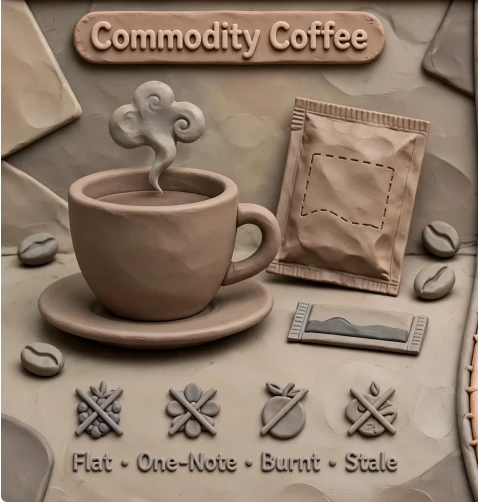
Why Your Commodity Coffee Tastes Boring - Good Coffee Has More Flavor Than You Think
Artisanal Coffee Trends to Watch in 2026