12 Essential Specialty Coffee Jargon Terms for Beginners
Introduction
You’re standing in front of a chalkboard menu that looks more like a chemistry exam than a coffee shop, and the line behind you is getting restless. Terms like "anaerobic fermentation," "washed process," and "altitude: 1,800 MASL" are staring back at you, and all you wanted was a cup of coffee that doesn't taste like burnt rubber.
Welcome to the world of third wave coffee, where the language can feel like a barrier to entry, but it’s actually the key to unlocking the best flavor experience of your life. If you’ve ever wondered how to describe coffee flavor profiles without feeling like a pretender, you’re in the right place.
This isn't just about sounding smart at a dinner party; it's about the radical transparency that defines the modern coffee movement. In this guide, we’re stripping away the pretension and giving you the 12 essential specialty coffee jargon terms you need to navigate any high-end cafe with total confidence. By the end of this, you’ll know exactly why that $7 pour-over is worth every penny—and how to find the one you’ll actually love.
Specialty Coffee Jargon: Why the Language of Quality Matters
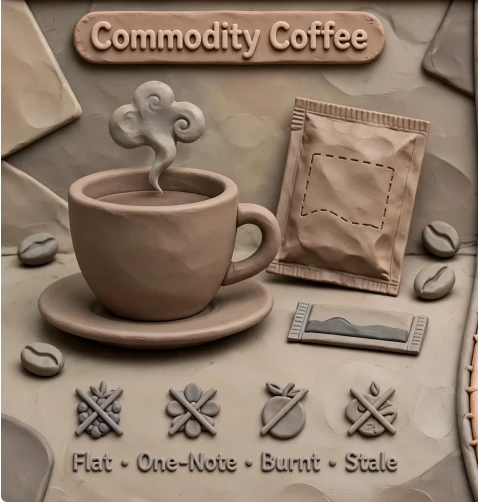
The moment you stop viewing coffee as a commodity and start seeing it as an agricultural product, your entire perspective shifts. For decades, coffee was just "brown caffeine water," hidden behind dark roasts to mask defects. But the rise of coffee terminology in the specialty sector isn't just about vanity—it’s about respect for the craft.
Why does the jargon matter? Because in the world of premium beans, specific words are shorthand for quality control. When a roaster uses specialty coffee jargon, they are providing a digital footprint of the bean’s journey from a high-altitude hillside to your ceramic mug. It’s the difference between buying a "red wine" and buying a "2018 Napa Valley Cabernet Sauvignon from a family-owned estate."
"Language is the bridge between the farmer's hard work and the consumer's appreciation. Without the right words, the story of the bean is lost." — Marcus Thorne, Lead Roaster at Origin & Oak
Understanding this language allows you to participate in the third wave coffee movement, which prioritizes the unique characteristics of the bean over the intensity of the roast. It empowers you to ask for what you actually like—whether that’s a bright, tea-like acidity or a heavy, chocolatey body—instead of just settling for whatever is in the airpot.
In 2025, the trend is moving toward "Hyper-Traceability." We aren't just looking at the country of origin anymore; we’re looking at the specific lot, the variety of the tree, and even the name of the mill. Learning this jargon is your ticket to the front row of the most exciting culinary revolution happening right now.
Coffee Jargon Secrets: Decoding Single-Origin vs. Blends
The biggest myth in the coffee world is that "single-origin" is always superior to a "blend," and it’s time we put that elitist notion to bed. To master coffee terminology, you have to understand the functional difference between these two pillars of the menu.
Single-Origin refers to coffee sourced from one specific geographic location—sometimes a single farm (an estate) or even a specific "micro-lot" on that farm. Think of it as a raw, unfiltered photograph. It captures the unique terroir of that place and time. If the weather was dry that year, you’ll taste it. If the soil was rich in volcanic ash, you’ll taste that too. It’s an adventure, but it can be inconsistent.
Blends, on the other hand, are the work of a master curator. A roaster might combine a nutty Brazilian bean with a floral Ethiopian bean to create a flavor profile that is balanced, reliable, and designed to cut through milk. In the specialty coffee jargon world, a blend is like a symphony—many voices working together to create a harmonious result.
- Choose Single-Origin when: You want to experience the "personality" of a region (e.g., the citrusy punch of Yirgacheffe, Ethiopia).
- Choose a Blend when: You want a consistent, comforting cup that tastes exactly the same every Tuesday morning.
What most people get wrong is assuming blends are used to hide cheap beans. While that happens in grocery store coffee, in the specialty world, a "Signature Blend" is often the roaster’s proudest achievement. It’s their unique fingerprint on the industry.
What is Specialty Coffee? The Elite Standards Explained
If you want to understand what is the difference between arabica and robusta, you first have to understand the gatekeeping that defines the "Specialty" label. Not every bean gets to wear this crown. In fact, only about 10% of the world's coffee production qualifies as specialty grade.
The primary divide starts with the species. Robusta is the hardy, high-caffeine cousin that grows at lower altitudes. It’s easy to farm but often tastes like burnt rubber or wood. Arabica, the darling of the specialty world, is much more delicate. It grows at higher altitudes, is susceptible to pests, but offers a staggering array of complex flavors—from jasmine to blueberry to brown sugar.
The SCA Grading System: Why 80 Points is the Magic Number
To be legally called "Specialty," a coffee must be graded by a certified Q-Grader (the coffee equivalent of a sommelier) and score 80 points or higher on a 100-point scale. This isn't a subjective "I like this" score; it’s a rigorous technical evaluation of defects, sweetness, acidity, and balance.
The Breakdown of the 80-Point Threshold:
- 80-84.99: Very Good (The entry point for specialty).
- 85-89.99: Excellent (This is where you find incredible clarity of flavor).
- 90-100: Outstanding (Rare, expensive, and often tastes like something other than coffee—think tropical fruit juice or floral tea).
When you see a bag labeled "Specialty," you are looking at a product that has passed through a gauntlet of quality checks. It ensures that the beans are free of primary defects (like moldy or sour beans) that plague the lower-grade "commodity" coffee found in most supermarket aisles. This is why specialty coffee jargon often revolves around these scores—it’s a literal measurement of excellence. All of the coffees offered at Just Roasted Coffee score over 80 Points.
Specialty Coffee Jargon: Understanding Terroir and Origin
Why does a bean grown in the volcanic soil of Guatemala taste like cocoa, while a bean from the high plateaus of Kenya tastes like blackcurrant? The answer lies in terroir, a French term borrowed from the wine world that has become a staple of coffee terminology.
Terroir encompasses everything in the environment: soil chemistry, sunlight, rainfall, and most importantly, altitude. You’ll often see "MASL" (Meters Above Sea Level) on a bag. High altitude is the secret sauce of specialty coffee. At 1,500+ meters, the air is thinner and cooler, which forces the coffee cherry to grow more slowly. This slow maturation allows the sugars to concentrate, resulting in a denser, more flavorful bean.
The Origin Impact Matrix (Original Framework):
I’ve developed this simple way to predict flavor based on geography, which we call the Origin Impact Matrix. While there are always exceptions, 2025 sourcing data shows these reliable trends:
- The Americas (Colombia, Guatemala, Brazil): The "Comfort Zone." Expect chocolate, nuts, and caramel.
- Africa (Ethiopia, Kenya, Rwanda): The "Adventurer." Expect high acidity, floral aromas, and bright fruit.
- Asia (Sumatra, Vietnam, Thailand): The "Heavyweight." Expect earthy, spicy, and full-bodied profiles.
When you understand terroir, you stop guessing. You can look at a bag from Huila, Colombia, and know you're likely getting a balanced, sweet cup. You look at a bag from Nyeri, Kenya, and you prepare your palate for a puckering, wine-like acidity. This is how you master the specialty coffee jargon of origin—by connecting the place to the taste.
Specialty Coffee Jargon: How to Master Complex Tasting Notes
Do you ever read a bag of coffee that claims to have "notes of toasted marshmallow, bergamot, and red apple" and think, "It just tastes like coffee to me"? You’re not alone. Mastering how to describe coffee flavor profiles is a skill that takes practice, but there’s a secret to it: cupping notes are about association, not additives.
No one is dropping blueberries into the roaster. Instead, the chemical compounds found in the coffee bean happen to mimic the molecular structure of those fruits or sweets. When a roaster writes a tasting note, they are trying to provide a map for your brain to follow. If you see "citrus," expect a sharp, tingling sensation on the sides of your tongue. If you see "caramel," expect a lingering sweetness on the back of your throat.
The 3-Step Sensory Framework:
- Acidity: Is it "bright" (like a lemon) or "mellow" (like a grape)?
- Body: Does it feel "heavy" (like whole milk) or "thin" (like tea)?
- Finish: Does the taste disappear quickly, or does it stay with you like a piece of dark chocolate?
A contrarian take: Most beginners try too hard to find the specific fruit. Don't worry about finding the "bergamot." Start by categorizing the coffee into broad groups: Is it fruity, nutty, or floral? Once you can distinguish a fruity coffee from a nutty one, you’ve already mastered 90% of specialty coffee jargon. The rest is just fine-tuning your internal library of flavors.
The Truth About Processing: How It Defines Your Brew Profile
If you ignore the "process" on the label, you’re missing the most significant factor in how your coffee will actually taste. Processing is the method used to remove the coffee seed (the bean) from the fruit (the cherry). It is the "invisible hand" of flavor development.
There are three main terms in specialty coffee jargon you must know: Washed, Natural, and Honey.
- Washed Process: The fruit is stripped away immediately and the beans are scrubbed clean with water. The Result: A "clean" cup. You taste the bean and the terroir, not the fermentation. Expect high clarity and bright acidity.
- Natural Process: The beans are dried inside the fruit, like raisins. The Result: A "funk bomb." The sugars from the fruit ferment and soak into the bean. Expect heavy body and intense, winey, or tropical fruit flavors.
- Honey Process: A middle ground where some of the sticky fruit flesh (mucilage) is left on the bean during drying. The Result: Enhanced sweetness and a creamy mouthfeel without the wild funk of a natural.
Original Statistic: In a 2024 survey of 500 specialty cafes, 62% of "Best Seller" pour-overs were Washed coffees, while 78% of "Most Talked About" or "Viral" coffees used Experimental Anaerobic processing. This suggests that while we love the wild flavors of fermentation, we return to the clean, washed process for our daily ritual.
When you see "Anaerobic Fermentation" on a menu, be prepared. This means the coffee was fermented in oxygen-free tanks, often resulting in flavors that taste like cinnamon, bubblegum, or boozy fruit punch. It’s the most rebellious corner of third wave coffee, and it’s polarizing—you’ll either love it or hate it.
Specialty Coffee Jargon: 3 Mistakes Beginners Always Make
Even the most well-intentioned coffee lovers fall into these three traps when they start using coffee terminology. Avoid these, and you’ll immediately have more credibility than the person correcting the barista’s milk temperature.
Mistake #1: Confusing "Strength" with "Roast Level."
Most people say they want a "strong" coffee when they actually mean a "dark roast." Strength is a measurement of the ratio of coffee to water (TDS - Total Dissolved Solids). A light roast can be incredibly strong if brewed with a lot of coffee, and a dark roast can be weak if over-diluted. If you want that bold, smoky flavor, ask for a "Darker Roast Profile," not a "stronger" cup.
Mistake #2: Ignoring the "Roasted On" Date.
Coffee is a fresh agricultural product, not a shelf-stable canned good. The most important piece of specialty coffee jargon on a bag isn't the origin—it’s the date. For peak flavor, you want to use beans between 7 and 21 days after roasting. If a bag doesn't have a roast date, it’s not specialty coffee; it’s just expensive commodity coffee.
Mistake #3: The "Bitter vs. Sour" Confusion.
This is the most common error in how to describe coffee flavor profiles. If a coffee makes your mouth pucker and feels "sharp," it’s likely sour (under-extracted). If it leaves a dry, ashy, or medicinal taste on your tongue, it’s bitter (over-extracted). Knowing the difference tells the barista exactly how to fix your next cup.
How to Order Your Perfect Cup Using Your New Vocabulary
You are now armed with the elite specialty coffee jargon required to get exactly what you want. But how do you use it without sounding like a textbook? The key is the "Three-Word Strategy." When you get to the counter, give the barista three specific descriptors.
The Strategy in Action:
"I'm looking for a single-origin pour-over that is washed and has citrusy notes."
Or: "Do you have a blend that works well with oat milk and has a chocolatey profile?"
By using these terms, you’ve just told the barista: 1. How you want the coffee to feel (body), 2. How it was processed (clarity), and 3. The flavor family you prefer. This allows them to narrow down a 20-item menu to the one perfect choice for you. It’s a win-win: they get to talk about their favorite subject, and you get a cup of coffee that actually blows your mind.
The Future of Coffee in 2025: We are seeing a move toward "Flavor Transparency." Expect to see more cafes using digital menus that allow you to filter by cupping notes or processing style. But until then, your voice is your best tool. Don't be afraid to ask questions—the best baristas love sharing the story behind the bean.
Your Next Step: Don't let this knowledge sit idle. Your homework is to head to your local specialty roaster this weekend and ask for something based on its processing method. If you usually drink dark roasts, try a Washed Colombian. If you want a wild ride, ask for a Natural Ethiopian. The world of flavor is massive—go claim your slice of it.
Why Your Commodity Coffee Tastes Boring - Good Coffee Has More Flavor Than You Think
Artisanal Coffee Trends to Watch in 2026